 EPCC
EPCCExpert-Play Contouring Control Faster-than-Demonstration Planning from Slow Expert and Fast Play
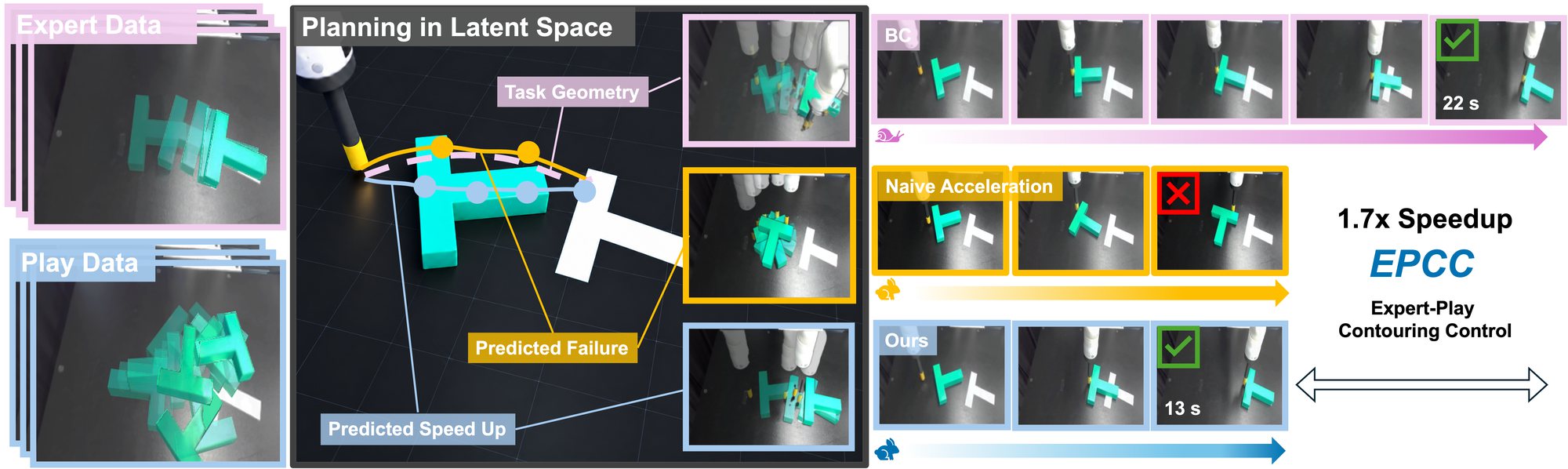
EPCC executes tasks faster than its demonstrations by pairing slow expert demonstrations with fast, non-expert play. Key idea: demonstrations say what to do; play shows how fast it can be done. Key result: 2.0× the throughput of the IL baseline on average, with gains concentrated in contact-sensitive phases, driven by play-trained dynamics and actions optimized beyond temporal rescaling.
| Throughput (1/s) ↑ | PushT | Cube | Slippery-PushT |
|---|---|---|---|
| DP[1] | .033 | .137 | .021 |
| SkiP[2] | .021 | .146 | −.003 |
| SAIL[3] | .037 | .241 | .018 |
| SuP[4] | .062 | .318 | .017 |
| EPCC (ours) | .068 | .282 | .039 |
Read the full abstract
Expert demonstrations often specify what a robot should do, but not how fast it can do it. Imitation Learning (IL) inherits demonstration timing, while directly accelerating the learned motion can fail when faster execution changes the robot–object dynamics. We study faster-than-demonstration execution as a dynamics-aware control problem and introduce Expert-Play Contouring Control (EPCC), which combines slow expert demonstrations with fast, non-expert play. Expert demonstrations train a latent trajectory generator whose predictions are reparameterized into a time-independent contour of successful task progression, while play trains a world model (WM) of fast-action outcomes. At deployment, our proposed planner uses the WM to optimize actions that maximize progress along the expert-derived contour while penalizing deviation from the intended task evolution. Averaged across three visuomotor manipulation tasks, EPCC achieves 2.0× the throughput of the IL baseline, including 2.2× the throughput of the strongest acceleration baseline on a task with interaction-sensitive object dynamics. Our analysis shows that the gains concentrate where faster execution changes robot–object evolution. Together, our results highlight a simple yet effective principle: demonstrations provide task intent, while play data provides the dynamic coverage needed to execute that intent faster. Our project page is available at https://expert-play-contouring.netlify.app/.
Real-world demonstration
Deep diveVisualizing planner inference
Play + Expert = ?
Does faster play lead to faster execution? Pick a play pace and see for yourself.
Deep diveSurprising: can expert demos from plain PushT guide EPCC on a slippery table?
Expert demonstrations come only from plain PushT (τ = 0). On every slippery table, EPCC gets zero expert demonstrations, only play collected on that table.
Faster-than-demonstration execution
Expert demonstrations often specify what a robot should do, but not how fast it can do it. Directly accelerating the learned motion can fail when faster execution changes the robot–object dynamics. EPCC uses fast, non-expert play to provide the missing fast-regime action–outcome evidence.
Policies trained from human demonstrations often inherit their slow and cautious execution, limiting throughput. Most prior work identifies phases during which the motion generated by the policy can be executed faster without changing outcome. It uses proxy cues for precision, such as motion complexity or semantic phase, and temporally compresses the identified segments through action downsampling, faster tracking or retiming[3][5][2][6][7]. These cues do not directly predict how robot–object dynamics change under faster execution.
For example, a careful push that stops an object at its target on a low-friction surface may instead send it diverging away from the target when executed faster (see the real-robot clip). Speeding up there requires understanding robot–object dynamics.
Our key insight is to separate task intent from fast-execution dynamics: slow expert demonstrations define the successful task evolution to preserve, whereas fast play reveals how actions change the robot–object evolution at higher speed.
Expert-Play Contouring Control
EPCC learns a latent world model from fast play to predict robot–object dynamics, and a contour generator from expert demonstrations to produce an expert-derived latent contour from the current observation. It combines them through receding-horizon contouring control, which optimizes actions to maximize progress along the latent contour while keeping predicted rollouts close to it.
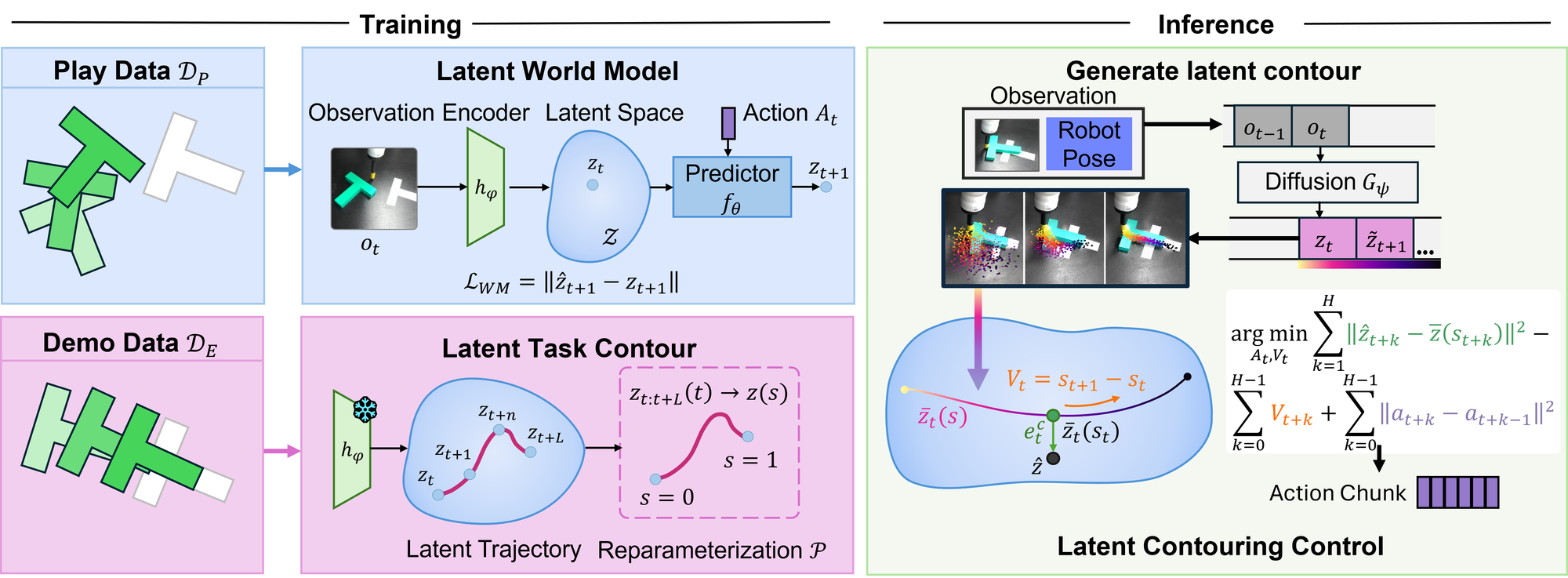
Learning a latent world model from play
Predict the next latent state from the current one and an action.
Visual observations are encoded into a compact latent state, and an action-conditioned latent dynamics model is trained on play transitions with a next-latent prediction objective[8][9]. Because the encoder observes both the robot and the manipulated scene, the learned dynamics capture task-relevant robot–object evolution.
Latent contour generation from expert demonstrations
Preserve the ordering of the generated task evolution and remove its timing.
The frozen world-model encoder encodes expert demonstrations into the same latent space, and a latent trajectory generator learns to predict the future latent sequence from the current latent state. A path reparameterization then removes the demonstrations' timing, turning this prediction into a contour that keeps the order of task progress and leaves its traversal speed to the controller.
Latent contouring control
Make maximal progress along the contour while limiting deviation from it.
Following model predictive contouring control[10][11], EPCC jointly optimizes the action sequence and progress along the contour with contouring, progress and action regularization costs. The contouring cost preserves the expert-derived task evolution, while the progress cost drives the predicted rollout forward as quickly as permitted by the world model. Replanning from every new observation, EPCC accelerates whenever faster execution stays consistent with the intended task evolution.
Deep diveContour, costs and optimization
World model. With \(z_t = h_\phi(o_t)\) and \(\hat z_{t+1} = f_\theta(z_t, a_t)\), play trains
Contour. The generator predicts \(G_\psi(z_t) = (\tilde z_{t+1|t},\ldots,\tilde z_{t+L|t})\). Each state gets a normalized cumulative path coordinate
and the contour \(\bar z_t:[0,1]\to\mathcal{Z}\) interpolates linearly between consecutive states, so \(\bar z_t(0)=z_t\) and \(\bar z_t(1)=\tilde z_{t+L|t}\).
Costs. With progress \(s_{t+k+1|t} = s_{t+k|t} + \nu_{t+k|t}\) and \(s_{t|t}=0\):
Optimization. At each control step EPCC solves
executes the first \(T_a\) actions and replans from the next observation.
When does dynamics-aware acceleration help?
EPCC gains most as interaction dynamics become more consequential and during contact-sensitive phases.
We compare against the imitation baseline DP[1] and three faster-than-demonstration methods, SkiP[2], SAIL[3] and SuP[4], on PushT, Cube[12] and the interaction-sensitive Slippery-PushT.
1Does richer dynamics awareness help?
On interaction-sensitive tasks, performance improves with richer dynamics awareness: from proxy-based SAIL and SkiP, to robot-state dynamics in SuP, to robot–object dynamics in EPCC.
| PushT | Cube | Slippery-PushT | ||||||||
|---|---|---|---|---|---|---|---|---|---|---|
| Dynamics | SR % | TTC s | TP 1/s | SR % | TTC s | TP 1/s | SR % | TTC s | TP 1/s | |
| DP | – | 88 | 24.3 | .033 | 96 | 6.8 | .137 | 68 | 28.8 | .021 |
| SkiP | proxy | 60 | 20.8 | .021 | 80 | 4.9 | .146 | 24 | 23.6 | −.003 |
| SAIL | proxy | 70 | 19.9 | .037 | 96 | 3.8 | .241 | 48 | 19.0 | .018 |
| SuP | robot state | 88 | 13.4 | .062 | 98 | 3.2 | .318 | 56 | 29.3 | .017 |
| Play+Goal | robot–object | 4 | 7.1 | −.016 | 0 | – | −.064 | 0 | – | −.017 |
| EPCC | robot–object | 90 | 12.2 | .068 | 96 | 3.3 | .282 | 74 | 17.7 | .039 |
Same 50 initial states per task; bold: best. Dynamics: what each method models to accelerate. Play+Goal: play-trained world model with a goal frame instead of the expert contour.
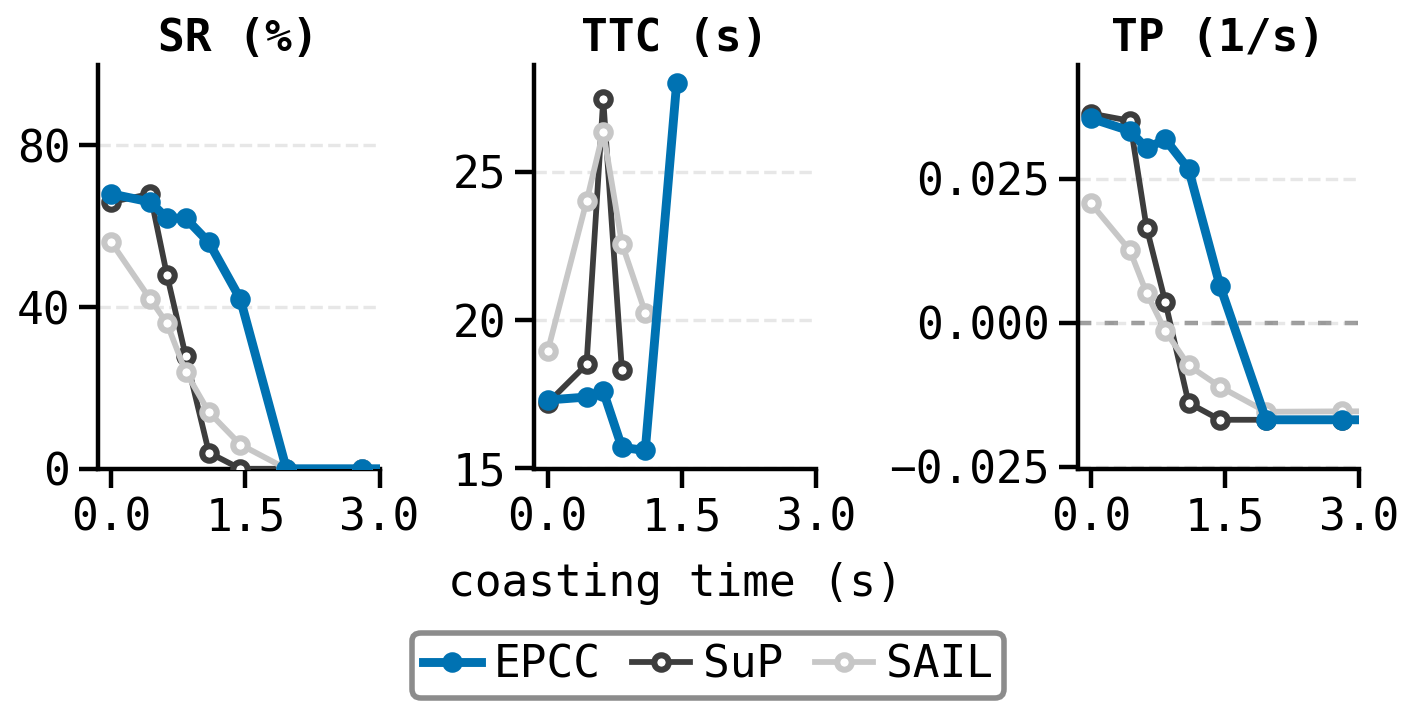
2What if robot–object interactions become more consequential?
EPCC and SuP perform similarly near the quasi-static regime; EPCC's advantage grows as coasting increases, with the same quasi-static PushT contour reused throughout.
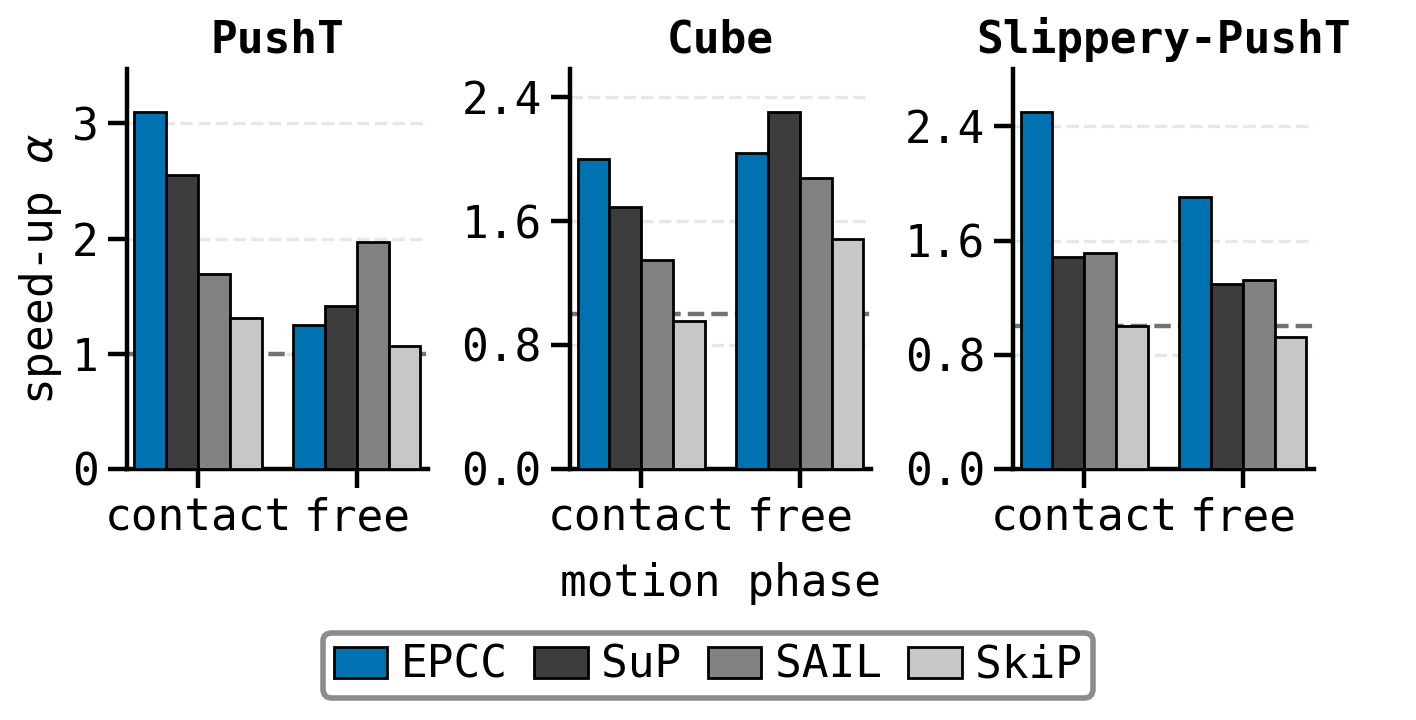
3Which phases gain the most?
The additional speedup concentrates in contact phases, where faster execution changes robot–object evolution; free-motion speedups are comparable. This also explains the weaker Cube result: its interaction-sensitive grasp and release phases are a small part of an episode.
Does play data provide useful actions beyond temporal rescaling?
Restricting acceleration to retimed policy outputs becomes increasingly limiting when faster execution changes robot–object evolution. Temporal candidates can nevertheless provide a useful warm start.
Under the same objective, Select executes the best temporally rescaled candidate of SuP[4], EPCC-WS refines it beyond the candidate set, and EPCC optimizes without policy-derived candidates.
| PushT | Cube | Slippery-PushT | |||||||
|---|---|---|---|---|---|---|---|---|---|
| SR % | TTC s | TP 1/s | SR % | TTC s | TP 1/s | SR % | TTC s | TP 1/s | |
| Select | 92 | 12.6 | .069 | 96 | 3.5 | .270 | 16 | 24.5 | −.005 |
| EPCC-WS | 94 | 10.0 | .092 | 78 | 2.6 | .281 | 60 | 20.2 | .030 |
| EPCC | 78 | 10.4 | .073 | 84 | 2.5 | .317 | 62 | 15.8 | .033 |
Action search vs. temporal scaling; bold: best.
The benefit is largest on Slippery-PushT; policy-derived candidates can aid initialization but are not required.
What play data is useful for acceleration?
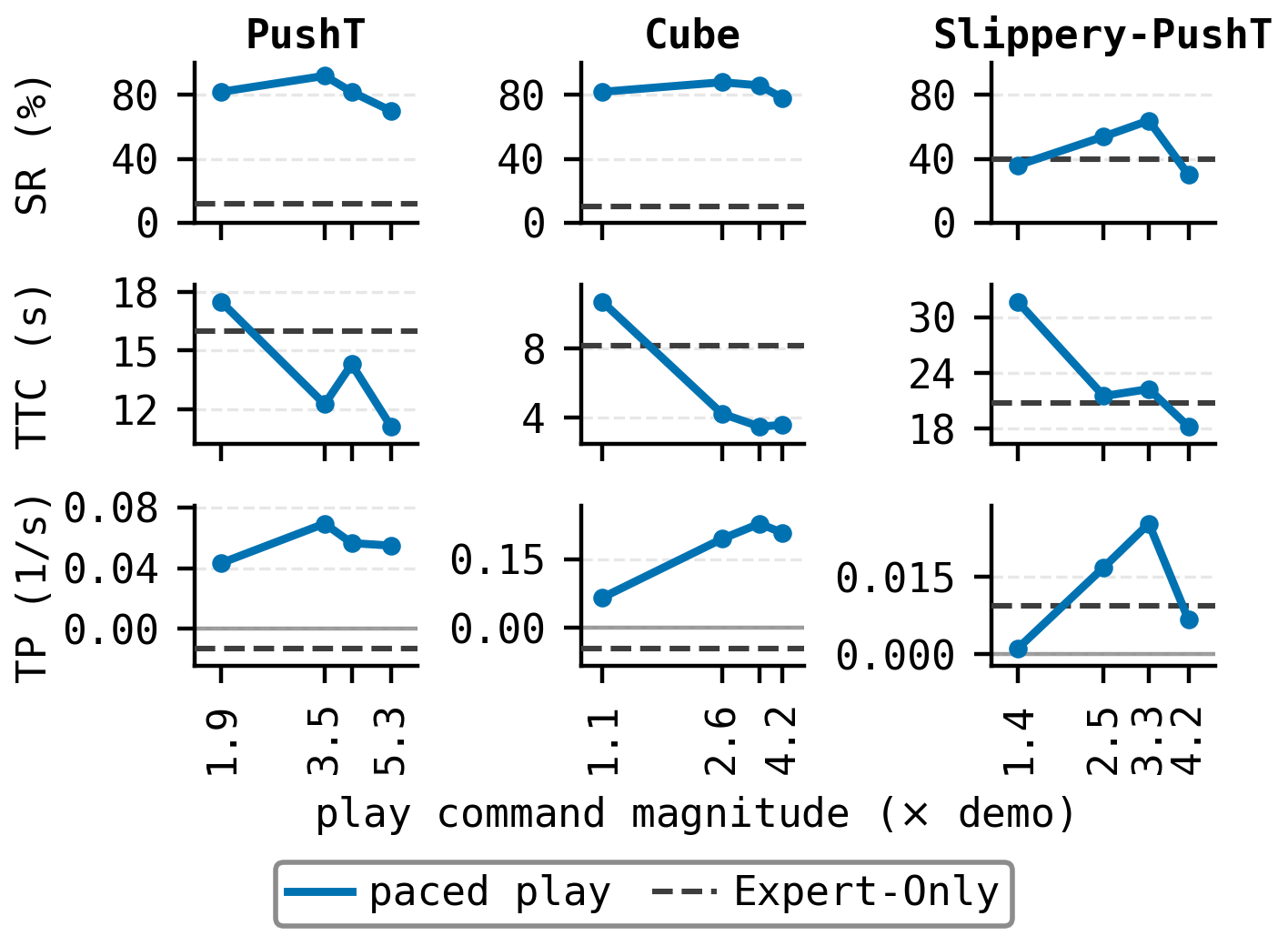
Useful play should be fast enough to cover the accelerated interaction regime without moving too far from the task-relevant dynamics.
With the expert contour generator fixed, only the world model's training data varies: expert data alone (Expert-Only) is not sufficient, play without the expert contour (Play+Goal) rarely succeeds, and performance peaks at an intermediate play pace.
Limitations and directions
- World-model accuracy and coverageEPCC depends on the accuracy and coverage of its world model. More targeted play-data collection may improve reliability.
- Planning costEPCC incurs additional planning cost. Faster world models may improve real-time performance.
References
- C. Chi et al. Diffusion policy: Visuomotor policy learning via action diffusion. The International Journal of Robotics Research, 2025.
- M. Dai et al. SkiP: When to skip and when to refine for efficient robot manipulation. arXiv:2605.15536.
- N. R. Arachchige et al. SAIL: Faster-than-demonstration execution of imitation learning policies. Conference on Robot Learning, 2025.
- Z. Wu et al. Speedup Patch: Learning a plug-and-play policy to accelerate embodied manipulation. arXiv:2603.20658.
- L. Guo et al. DemoSpeedup: Accelerating visuomotor policies via entropy-guided demonstration acceleration. arXiv:2506.05064.
- B. Kim et al. ESPADA: Execution speedup via semantics aware demonstration data downsampling for imitation learning. IEEE Robotics and Automation Letters, 2026.
- S. Kim et al. Time optimal execution of action chunk policies beyond demonstration speed. International Conference on Learning Representations.
- G. Zhou et al. DINO-WM: World models on pre-trained visual features enable zero-shot planning. arXiv:2411.04983.
- L. Maes et al. LeWorldModel: Stable end-to-end joint-embedding predictive architecture from pixels. arXiv:2603.19312.
- D. Lam et al. Model predictive contouring control. IEEE Conference on Decision and Control, 2010.
- M. Krinner et al. MPCC++: Model predictive contouring control for time-optimal flight with safety constraints. 2024.
- L. Maes et al. stable-worldmodel: A platform for reproducible world modeling research and evaluation. arXiv, 2026.